Back to projects

Governance and forecast quality

Infoblox CRM governance and forecasting

I standardised CRM governance and KPI definitions across sales, finance, and supply, so planning meetings stopped fighting about whose numbers were right and started feeding real go-to-market calls.

Employer / client
Infoblox
Duration
Jan 2020 - Apr 2022
Project type
Data and analytics

Architecture and GTM map

From governed data to go-to-market

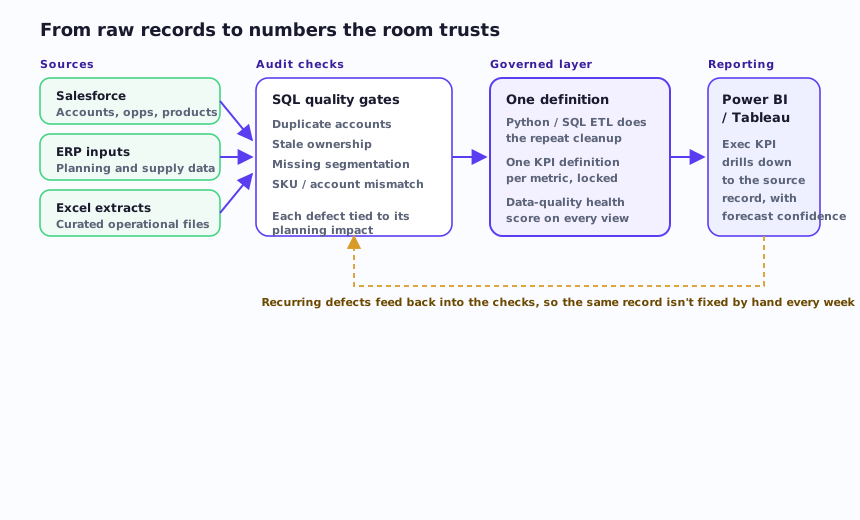
Architecture diagram: Salesforce, ERP, and Excel sources flow through SQL quality gates into a governed layer with locked KPI definitions and a data-quality health score, then into Power BI and Tableau, with defects looping back to the checks.

Raw records pass through SQL quality gates into a governed layer with locked KPI definitions and a health score, then into reporting. Defects loop back into the checks.

CRM governance architecture
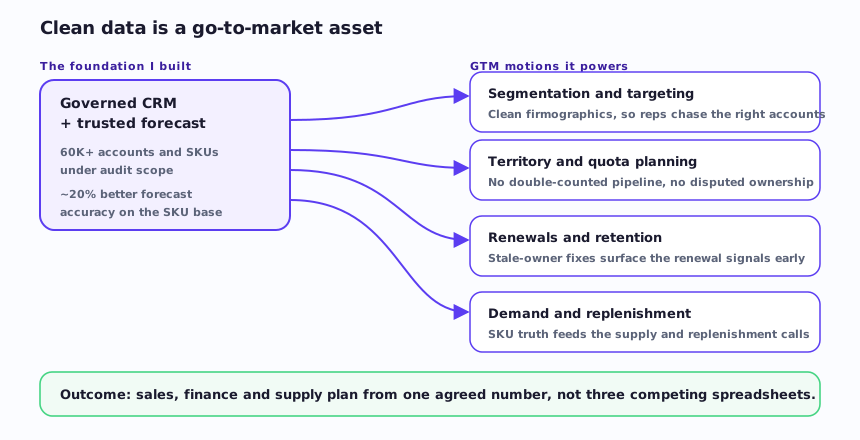
GTM enablement map: governed CRM data and a trusted forecast fan out into four go-to-market motions: segmentation and targeting, territory and quota planning, renewals and retention, and demand and replenishment planning.

The same governed data and trusted forecast fan out into four go-to-market motions, so sales, finance, and supply plan from one agreed number.

GTM enablement map

Process flow

How I work the steps

  1. 01
    before Source pull

    Salesforce, Excel, and ERP-style inputs gathered for the recurring review.

    BA / Data
  2. 02
    control Quality checks

    Duplicates, stale ownership, segmentation, and mismatch checks run.

    BA
  3. 03
    handoff Field UAT / requests

    Missing fields tested and requested through IT/Product Manager where needed.

    BA / IT
  4. 04
    after Dashboard drilldown

    KPI view ties back to source-record confidence.

    BA / BI

How I worked the problem

  • Ran KPI-definition workshops to surface where teams were using the same metric name to mean different things, then locked the shared definitions down before anyone touched a dashboard.
  • Built SQL audit checks for duplicates, missing segmentation, stale ownership, and SKU-account mismatches across CRM, ERP, and the curated Excel inputs.
  • Worked with data engineering on Python/SQL ETL so the recurring cleanup moved from manual edits into a repeatable reporting flow.
  • Designed Power BI navigation that went from the executive KPI down to the transaction record, so any challenged number could be traced back to source.
  • Tied the clean data and the forecast straight into the go-to-market calls it fed: segmentation, territory and quota planning, renewals, and demand or replenishment planning.

Measured results

What I delivered

60K+ volume

Accounts/SKUs governed

Audit scope across account and SKU records.

~60% cycle-time

Reporting cycle reduction

Python/SQL ETL killed the repeated manual fixes and waiting time.

~20% accuracy

Forecast accuracy improvement

Cleaner lifecycle, usage, and sales signals lifted forecast confidence.

Outcomes

  • Duplicate accounts, stale owners, and SKU mismatches got caught at the source instead of derailing the operating review.
  • Reporting stopped being a reconciliation exercise. Python and SQL handled the repeat cleanup so the same records weren't fixed by hand every week.
  • Replenishment and renewal conversations started from a number the room actually agreed on, because the dashboard told you how confident it was.
  • The go-to-market motions that ran on this data, segmentation, territory and quota planning, renewals, and replenishment, all started from the same trusted base.

Tools I used

  • Salesforce
  • SQL
  • Python
  • Power BI
  • ETL
  • Data quality