Back to projects

Technical depth / education

AI business analyst practice: automation, models, and governance

How I work as an AI business analyst. I find the business problem first, decide if AI is even the right tool, then build with Cursor and Claude or run a local model when the data can't leave the machine. Same critical thinking I use on CRM and governance work, pointed at automation that has to stay compliant.

Employer / client
Personal practice & Outlier contract work
Duration
2024 to present
Project type
AI business analysis

Architecture and operating model

How AI actually fits a BA workflow

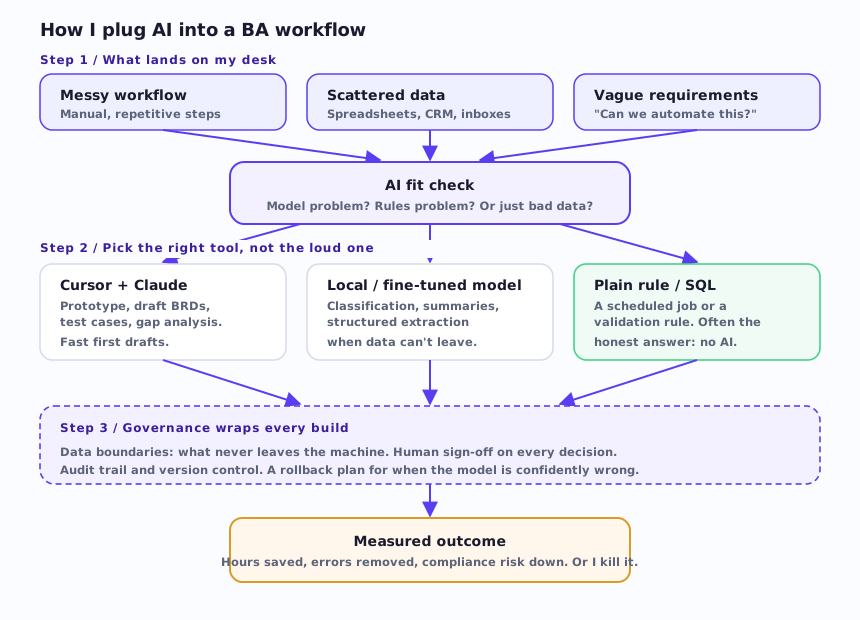
Operating model diagram: a messy workflow passes an AI fit check, drops into one of three solution lanes (Cursor and Claude, a local model, or a plain rule), is wrapped in a governance band, and ends in a measured outcome.

How I plug AI into a BA workflow. The problem passes a fit check, drops into one of three lanes, gets wrapped in governance, and ends in a measured outcome.

My AI-BA operating model
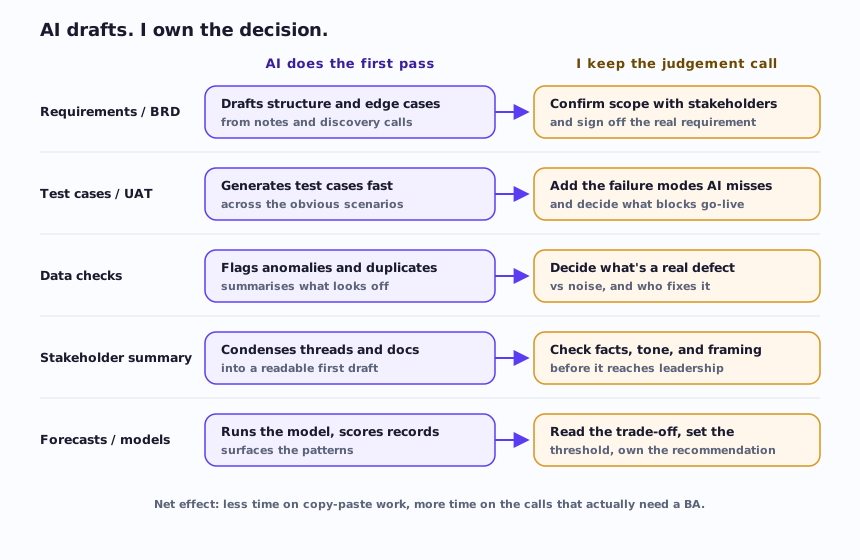
Two-column map: for requirements, test cases, data checks, summaries, and forecasts, AI does the first pass on the left and the human keeps the decision on the right.

For each core BA task, AI does the first pass and I keep the decision. Less copy-paste, more judgement.

AI-augmented BA workflow

Process flow

How I work the steps

  1. 01
    before Map the process

    Current steps, owners, pain, and what success looks like in business terms.

  2. 02
    control AI fit check

    Is this a model problem, a rules problem, or a data-quality problem?

  3. 03
    after Prototype

    Cursor/Claude build or local model setup with test cases from real examples.

  4. 04
    control Guardrails

    Privacy, bias, audit trail, human sign-off, and rollback plan.

  5. 05
    after Measure

    Hours saved, error rate, adoption. Kill it if the metric does not move.

How I built it

  • Mapped my own workflows the way I'd map a CRM process: steps, owners, failure modes, and what 'done' means.
  • Built and kept real tooling running with Cursor and Claude: this site, a job tracker, and a résumé-tailoring flow that has to sound like me, not a template.
  • Ran local and task-specific models where cloud APIs were too generic or too leaky, for classification, summarising, and structured extraction.
  • Wrote the guardrails first: what data never leaves the machine, what needs a human sign-off, what gets logged, and what happens when the model is confidently wrong.

Measured results

What I measured

3+ volume

Workflows automated

Portfolio, job tracking, and résumé tailoring pipelines with human review gates.

Hybrid comparison

Model approach

Cloud assistants for drafting, local or fine-tuned models when data sensitivity or repeatability matters.

First sla

Governance habit

Data boundaries, review checkpoints, and explicit "do not automate" calls documented before build.

Findings

  • Three working pipelines (portfolio, job tracking, résumé tailoring) built with Cursor and Claude, version-controlled and deployable, so every change is traceable.
  • Local and fine-tuned model setups for the tasks where generic APIs weren't stable or private enough.
  • Outlier evaluation work that sharpened the same muscle: rubric-based judgement and spotting an answer that reads fluent but fails the brief.
  • What I'd bring to your team: an automation scout who ties every proposal to hours saved, errors removed, or risk reduced, and who flags when AI only moves the work somewhere else.

Tools I used

  • Cursor
  • Claude
  • Python
  • Local LLMs
  • Prompt engineering
  • Git